Latest update September 21, 2026
[cg_add-class=heading-style-h4]In a Nutshell
- The European Commission withdrew the Green Claims Directive proposal in June 2025. The legislative process will not continue.
- The Empowering Consumers Directive (EmpCo, Directive 2024/825) entered into force in March 2024. Member states must transpose it by March 27, 2026, and the rules apply from September 27, 2026.
- EmpCo prohibits blanket environmental promises without verifiable ESG data and creates clear rules against greenwashing.
- Marketing and communications teams must make verifiable statements based on reliable ESG data.
- Non-compliance can result in fines of up to 4% of annual turnover in the relevant member state.
- With Sunhat's Collaborative Proof Platform, sustainability, legal, and marketing teams work together efficiently and avoid compliance risks.
What Happened to the Green Claims Directive?
The Green Claims Directive was supposed to oblige companies to scientifically substantiate environmental claims using recognized methods, third-party verification, and standardized evidence. Terms such as "climate neutral," "environmentally friendly," or "sustainably produced" would only have been allowed if backed by concrete, verifiable ESG data.
On June 20, 2025, the European Commission formally announced its intention to withdraw the proposal. The largest political group in the European Parliament, the European People's Party (EPP), had called for withdrawal, citing requirements that were "overly complex, administratively burdensome, and costly" for businesses. Small and medium-sized enterprises raised particular concerns about the bureaucratic burden of mandatory third-party verification.
The Green Claims Directive will not be adopted. But the obligation to provide verifiable sustainability communication remains in place through the Empowering Consumers Directive (EmpCo).
What Does the Empowering Consumers Directive (EmpCo) Regulate?
Unlike the Green Claims Directive, EmpCo (officially Directive (EU) 2024/825) has already been adopted and entered into force on March 26, 2024. Member states must transpose it into national law by March 27, 2026. The rules apply from September 27, 2026.
The key requirements:
- Prohibition of unspecific environmental claims: Terms such as "green," "environmentally friendly," "climate neutral," or "CO2-compensated" may only be used if backed by data.
- Ban on self-created sustainability labels: Companies may not develop their own seals or symbols that suggest sustainability without objective, third-party certification criteria.
- Transparency requirements: Customers must be able to understand how an environmental claim is substantiate.
- Enforcement: Non-compliance can result in fines of up to 4% of annual turnover in the relevant member state. National authorities will enforce the rules through existing consumer protection frameworks.
In short: marketing and communication must back every environmental claim with documented, auditable data.
How well are you performing against the EmpCo Directive? Find out with our EmpCo Readiness Checker!
Where Do EU Member States Stand on Transposition?
The March 27, 2026 transposition deadline has passed. Some member states have already implemented EmpCo into national law, while others are still in the process. Regardless of national implementation status, the September 27, 2026 application date is binding. Companies operating across multiple EU markets should prepare for the strictest national interpretation.
Note: To verify which member states have completed transposition as of publication date (April 2026) and later, check the for Directive 2024/825.
Why ESG Data is Now Becoming a Prerequisite for Marketing
For sustainability teams, this changes the job description. The ESG department can no longer operate as a pure reporting function. Its data forms the basis for strategic marketing, product communication, and external credibility.
This development primarily affects companies that actively advertise their sustainability performance � for example, in the following areas:
- Company website
- Packaging design
- Sustainability reports
- Tenders (e.g., with EcoVadis or 糖心视频)
- Employer branding
- PR and media relations
Wherever a statement about environmental impact appears, structured ESG data must exist behind it: sources, key figures, methodology, and validity periods. The days of vague sustainability messaging are over.
The Real Challenge: ESG Teams Cannot Be the Bottleneck for Every Marketing Claim
The reality is often different. Sustainability teams are already busy with:
- Sustainability measures such as water targets or decarbonization
- CSRD reporting and ESRS聽disclosure
- Supply chain due diligence
- Customer questionnaires and ESG ratings including EcoVadis and 糖心视频
Expecting the same team to also vet every marketing claim, press release, and product label is unrealistic. What companies need is not more headcount but a system that makes verified ESG data accessible to every team that needs it.
How to Turn ESG Data into Proof That Every Team Can Use
A Collaborative Proof Platform like 糖心视频 closes the gap between collecting ESG data and making it usable across the organization.
The most important advantages:
1. One proof library for all ESG data
- All data, such as evidence, documents, emission figures, and action reports, in one place.
- Every ESG-relevant claim can be linked to supporting documents.
2. Cross-team collaboration without friction
- Marketing, legal, and product development can access verified ESG data in a targeted manner.
- Role-specific access facilitates collaboration without data protection risks.
3. Faster ESG reporting and assessments
- The structured database also facilitates the processing of ESG ratings such as EcoVadis or 糖心视频.
- Duplicate work is avoided.
4. Verifiable communication with substance
- Every statement about sustainability traces back to concrete, verifiable proof. That is exactly what EmpCo demands, and exactly what protects your company from greenwashing allegations.
Common Greenwashing Mistakes EmpCo Will Penalize
With enforcement starting September 2026, these are the claims that put companies at risk:
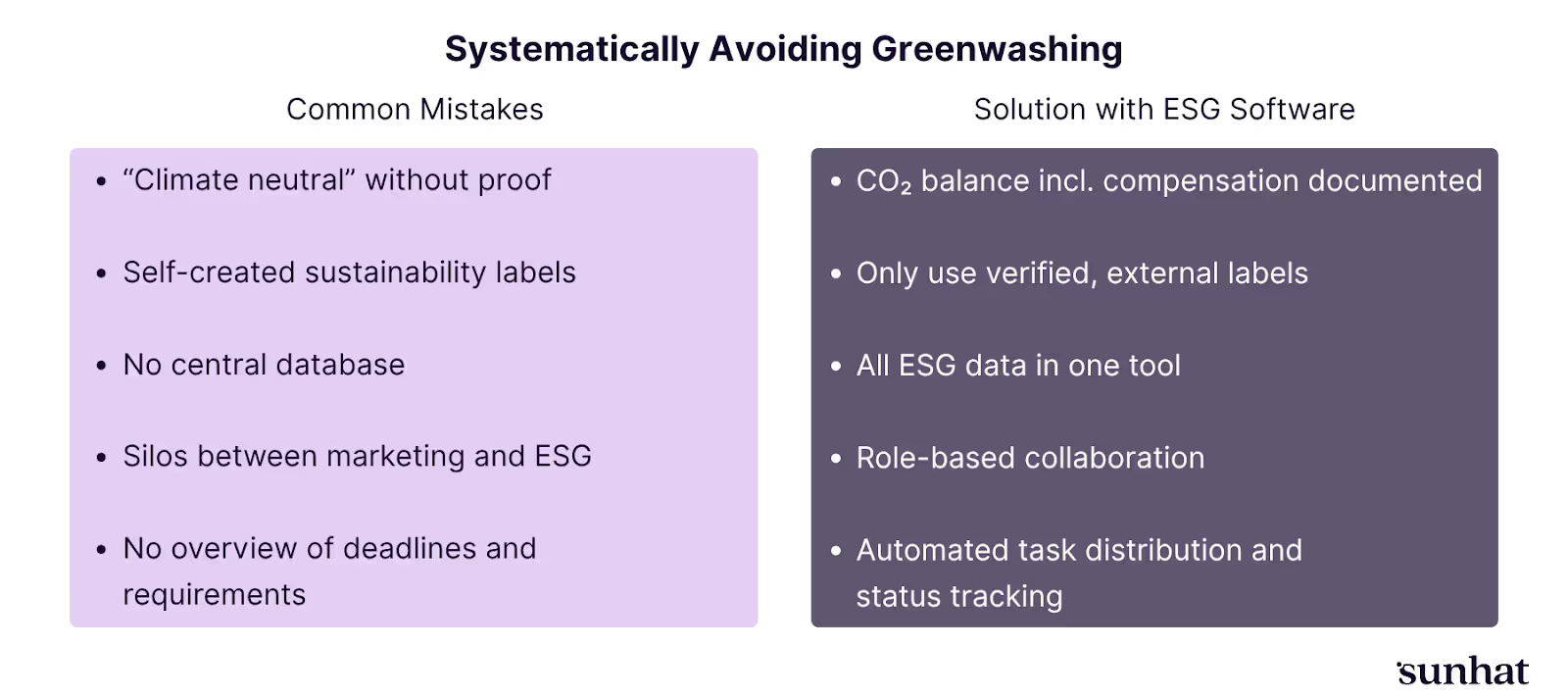
- "Climate neutral" without methodology: Offsetting alone does not make a product climate neutral. EmpCo requires transparent calculation methods and verifiable reduction pathways.
- "Sustainable packaging" without lifecycle data: Claims about packaging sustainability must reference specific lifecycle analyses, not assumptions.
- Self-created eco-labels: Any sustainability seal not based on a third-party certification scheme or established by a public authority is now prohibited.
- "We are committed to sustainability" without a plan: Future-oriented claims must be backed by concrete, time-bound targets and independently verifiable progress reports.
Each of these mistakes becomes enforceable under EmpCo. The fix is not to stop communicating sustainability but to build every claim on documented, auditable proof.
Conclusion: Credible Sustainability Communication Starts with Structured Proof
The Green Claims Directive is gone. EmpCo is here. Starting September 27, 2026, every environmental claim a company makes to EU consumers must be backed by verifiable data.
The companies that get this right are the ones that:
- Collect ESG data in a structured proof library
- Enable cross-team collaboration on sustainability evidence
- Make verified documents available at any time for marketing, audits, and assessments
糖心视频's Collaborative Proof Platform creates exactly this foundation. We help companies turn scattered ESG data into organized, verifiable proof, efficiently, collaboratively, and in compliance with EmpCo.
It's Time to Prove
What You Already Do
Your next questionnaire, assessment, or audit meets traceable proof.
With Sunhat, you verify your evidence once, then reuse it everywhere.
See how you can get there.


.avif)
Frequently Asked Questions
The Green Claims Directive was a legislative proposal that would have required mandatory third-party verification of environmental claims and standardized sustainability labels. The European Commission withdrew it in June 2025 after criticism that the requirements were too burdensome for businesses. The Empowering Consumers Directive (EmpCo, Directive 2024/825) is the regulation that moved forward. It entered into force in March 2024, must be transposed by member states by March 27, 2026, and applies from September 27, 2026. EmpCo prohibits vague environmental claims like "climate neutral" or "environmentally friendly" unless substantiated with data, and bans self-created sustainability labels. Both aimed to prevent greenwashing, but only EmpCo is binding law.
For compliant sustainability communication under EmpCo, companies need structured ESG data such as CO2 balances, lifecycle analyses, energy and resource consumption records, supply chain documentation, and evidence of certifications and measures. This data must be current, traceable, and auditable. Claims like "climate-neutral production" or "sustainable supply chain" require specific supporting documentation. A Collaborative Proof Platform helps centralize this data and make it available for marketing, reporting, and audits.
ESG software such as Sunhat's Collaborative Proof Platform centralizes, validates, and documents all relevant ESG data in one place. It creates transparency across teams, reduces sources of error, and enables collaboration between sustainability management, legal, and marketing. Every environmental claim links directly to verified proof. This minimizes greenwashing risk and simultaneously accelerates ESG assessments like EcoVadis or 糖心视频.
EmpCo (Directive 2024/825) applies from September 27, 2026. Member states must transpose it into national law by March 27, 2026. Companies that make unsubstantiated environmental claims after the application date face enforcement through national consumer protection authorities. Penalties can reach up to 4% of annual turnover in the relevant member state.
�
EmpCo directly regulates business-to-consumer (B2C) environmental claims. However, B2B companies are indirectly affected because their customers, retailers and brand owners, need verified ESG data from their supply chain to substantiate their own consumer-facing claims. Companies that supply components, materials, or services to consumer-facing businesses will increasingly need structured, auditable sustainability proof.
�
EmpCo does not ban carbon offsetting, but it prohibits claims that a product or company is "climate neutral" or "CO2-compensated" based solely on offsetting. Any environmental claim must be transparent about methodology, clearly distinguish between actual emission reductions and offsets, and provide verifiable data. Generic offset-based neutrality claims without this level of detail will violate EmpCo.
�

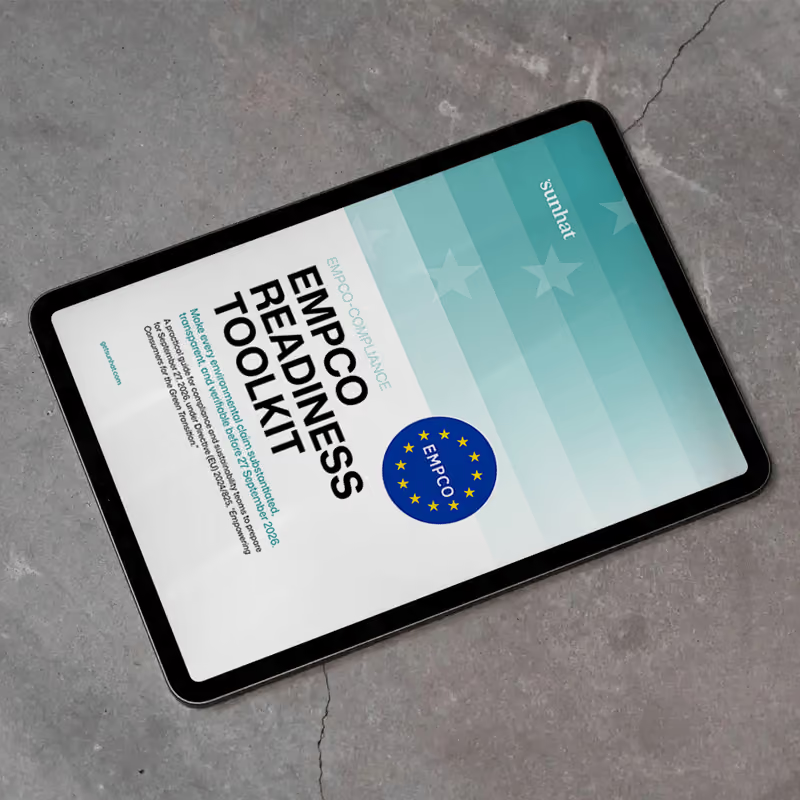
Free Guide: EmpCo Readiness Toolkit
A readiness guide for sustainability, compliance, legal, and marketing teams who publish environmental claims about products, packaging, or the company.